October 30, 2026
Is the Bank of Canada Done Hiking? History Says No
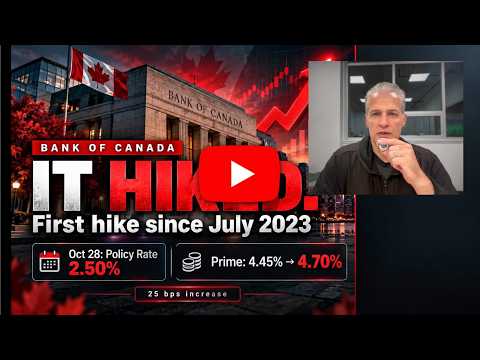
On Wednesday, October 28, the Bank of Canada did what everyone had been arguing about for months — it hiked. The policy rate rose 25 basis points to 2.50%, the first increase since July 2023, and prime moved from 4.45% to 4.70%. The Bank wouldn’t say whether this is a one-off. History, however, has a pretty clear opinion.
Why the Bank Hiked
The Bank’s worry is simple: that high energy prices stop being an energy story and start becoming an everything story. Governor Tiff Macklem said there could be a need to raise the rate further, but that given the uncertainties, the Bank will proceed carefully. That one word is doing a lot of work.
One Hike Is Never Just One Hike
Since late 2000, the Bank of Canada has announced rate decisions on a fixed schedule of eight dates a year — an orderly, heavily anticipated calendar, not the minute-by-minute chaos of the stock or bond markets. And since that schedule began, every tightening cycle has involved more than one hike.
Go back to mid-1994 and there’s still no one-hike precedent. July 2007 is the only arguable exception, and even that was a follow-up in a cycle that started in 2004. One-and-done rate hikes are basically Canadian unicorns.
The market agrees. It has priced in five hikes through 2031 — three in the next 12 months — and puts the odds of another hike in December at about 45%.
What does “priced in” mean? Think of it like a lender locking in your rate today for a mortgage that funds next year. If they expect rates to rise, the rate they quote you will already be higher. Big investors are doing that right now — locking in higher rates today because they expect the Bank to keep going.
Even many dovish economists aren’t debating whether more tightening is coming — only whether it stops at 2.75% or pushes past 3.00%. My read: don’t plan your mortgage around the idea that this was the whole story. Plan around it being the first chapter.
Not Everyone Loved the Timing
The decision had critics. BCREA pointed to 110,000 jobs shed over two months and argued the Bank could have waited for more data. Ontario Premier Doug Ford called it a “massive mistake.” Avery Shenfeld, one of Bay Street’s most-watched economists, warned that moving early could be a step the Bank comes to regret.
But the Bank concluded that waiting risked having to hike harder later. The decision is made — now it’s about planning around it.
The Economy the Bank Just Hiked Into
It’s a confusing picture.
- Growth: 3.3% annualized in Q2, with the Bank forecasting 1% for 2026 and 2% in both 2027 and 2028. Resilient given a trade war and an energy shock — but not strong, and not the kind of growth that drives inflation on its own.
- Jobs: Unemployment is around 6.5%, and the Bank expects growth to slow in the fourth quarter.
- Housing: In September, national sales fell 2.3% from August and 7.5% year over year. The national benchmark price was $651,400, down 3.4% from a year earlier. B.C.’s benchmark is down 4.7% with 8.4 months of inventory; Alberta’s is down just 0.4%.
- Inflation: Headline inflation is above 3%, and the Bank expects about 3.5% by year-end and an average of 3% through 2027 — a full point above its July projection — before returning to 2% around mid-2028.
Here’s the key detail: core inflation — the measure that strips out volatile items like food and energy — is still near 2%, and inflation excluding gasoline was 2.2% in September. The Bank isn’t fighting runaway inflation across the board. It’s trying to stop an energy spike from spreading into everything else.
What This Means for Your Mortgage
It depends entirely on what kind of mortgage you have.
Adjustable-rate (variable) mortgage
With an adjustable-rate mortgage, you feel this right away. On a $500,000 mortgage at about 3.70% with a 25-year amortization:
| Scenario | Approx. rate | Monthly payment increase vs. before the hike |
|---|---|---|
| October 28 hike (+0.25%) | 3.95% | ~$67 |
| One more hike (+0.50% total) | 4.20% | ~$135 |
| Two more hikes (+0.75% total) | 4.45% | ~$204 |
Not a crisis on its own — but it adds up if the cycle continues.
Static-payment variable mortgage
With a static-payment variable, your payment stays the same when prime rises; more of it simply goes to interest and less to principal. You probably won’t feel real pain unless this becomes a 175 to 225 basis point cycle that reaches your trigger rate.
Fixed-rate mortgage
Nothing changes until renewal. But fixed rates follow the bond market, which already has future hikes baked in. Locking in purely out of nerves now could mean locking near the top of the fixed-rate cycle. Don’t panic-lock — run the numbers with an experienced broker first.
Variable Is Not Dead
You might be thinking: rates are going up — why would anyone choose variable now? It’s a fair question, and the answer is the spread.
Before this hike, the best insured five-year variable sat around 3.45%, compared with about 4.44% for a competitive five-year fixed. Even after prime moved this week — and even after another hike — that gap is real money every month.
A few strategies make variable work even better:
- Pick the right product. Static-payment variables keep your payment steady; adjustable-payment variables keep your amortization on schedule.
- Pay like it’s fixed. Set your variable payment as if you were paying the market five-year fixed rate. The difference goes straight to principal.
- Keep a cash buffer for the months when prime rises.
- Know your trigger rate before you sign.
Variable isn’t for everyone. If a rising payment would keep you up at night, fixed is your answer. But don’t let the word “hike” scare you out of running the numbers.
Renewals Are Where This Cycle Really Shows Up
Over the next 12 months, about 12% of all outstanding mortgages — the last of the pandemic-era five-year fixed-payment mortgages — will renew with payments roughly 15% higher on average. If you’re in that group, start the conversation early.
Mortgage Tip of the Week: Read Your Conditions Page the Same Day
When your mortgage approval arrives, read the conditions page that same day — not just the approval. Note your financing condition deadline if you’re buying, or your maturity date if you’re renewing, and answer anything the lender asked you to confirm right away, even if it looks like a one-line question.
Lenders don’t chase you; the clock just keeps running. The borrowers who close smoothly aren’t the ones with the cleanest files — they’re the ones who reply to the small stuff the same day.
What to Watch Next
- November 16: the inflation report — the only one the Bank sees before its December decision. It either confirms the Bank’s worry or gives it room to pause.
- December 9: the next rate decision. One forecast based on CORRA leans toward a hold in December and a hike in January. That disagrees with the market’s 45% December odds, which is exactly what makes December interesting.
- January 27 and March 3: the Bank’s following announcements.
The Bottom Line
Don’t bet your mortgage on a unicorn. Assume more hikes are coming, know exactly what kind of mortgage you’re in and when it reprices, and if you’re renewing in the next year, start that conversation now — while you still have choices, not deadlines. And don’t let the headlines talk you out of variable without running your own numbers first.
Ready to talk about your mortgage?
I’m Marko Gelo, a dually licensed mortgage broker in BC and Alberta. Call or text me at 604-800-9593 — one application, one credit check, and access to Canada’s top lenders.
Connect with Marko
Mortgage strategy, calculators, and direct access—without the bank-branch waiting room.
604-800-9593 ph1 | 403-606-3751 ph2 | mortgages@markogelo.ca
Download the Mortgage App for calculators and planning tools, or subscribe to get future posts delivered directly to your inbox.