October 23, 2026
Looking ahead to next week:
This past week, the economic headlines and the housing numbers went in opposite directions. Inflation ticked up to 3.1%. The bond market is betting harder on a Bank of Canada rate hike, possibly as early as Wednesday, October 28. And meanwhile, home prices in Vancouver, Calgary and Edmonton are flat to falling.
That’s the vibe right now. So whether you’re a buyer wondering if this fall is your window, or a homeowner wondering what next week’s rate decision means for your payment, here are the seven storylines that connect the dots between gas prices, bond yields and what’s actually happening on the ground in Western Canada’s three biggest markets.

Storyline #1: Inflation Is Up, and Gas Is Doing the Heavy Lifting
Canada’s Consumer Price Index rose 3.1% year over year in September, up from 3.0% in August.
On the surface that sounds bad, and it is. But almost all of the heat is coming from one place: the gas pump. Gasoline prices were up nearly 28% from a year earlier, and fuel oil, which much of Atlantic Canada uses to heat their homes, was up almost 58%. Both are tied to the conflict in the Middle East and the ongoing disruption in the Strait of Hormuz, a major oil shipping route.
Pull energy out and inflation drops to about 2.1%, right around the Bank of Canada’s 2% target. There were a few genuine bright spots, too:
- Groceries rose just 1.7%, the smallest annual increase since May 2024. Fresh vegetables actually got cheaper.
- Shelter costs rose only 1.8%, and the mortgage interest cost index dipped slightly.
- Rent rose 2.8%, unchanged from August.
But let’s not sugarcoat it. Grocery prices are still up about 33% since September 2020. Slower increases don’t mean prices are coming down. They just mean they’re climbing less steeply.
My take: stop stripping gas out of the story
I’ll be honest, I’m getting tired of hearing that oil and gas are “noise” to be stripped out of inflation, as if they’re a temporary blip. For a lot of us, energy is the cost of living.
Here in Vancouver, we celebrate when gas dips under $2 a litre. Think about that. Pump prices in Vancouver have been above a dollar for roughly a quarter century, and they first broke the $2 barrier about five years ago. I remember when $1.60 felt expensive, and then I realize that was back around 2014. Isn’t it remarkable how quickly we get used to things?
So when the headline gets softened with a core inflation number that conveniently leaves out what people pay at the pump, it can be misleading. It’s a bit like stepping on a scale, subtracting the weight of your legs, and telling everyone how much you weigh.
And it raises a bigger question about energy policy. We spent years pushing hard on green energy, which is fine, but at the same time we turned down a lot of pipeline and refinery projects in Alberta. Had we moved forward with more of that infrastructure while also investing in the green transition, I suspect Canada would be in a much stronger position today. The irony? If you’d told me 15 years ago that a Liberal government would be the one moving the next big pipeline forward, I wouldn’t have believed you. Yet here we are.
Story line #2: 80% chance of a hike
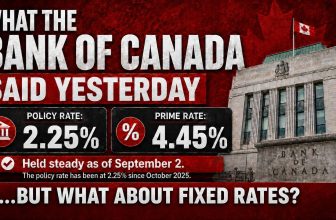
The Bank of Canada’s next rate announcement is Wednesday, October 28. Its policy rate is sitting at 2.25%, which translates to a prime rate of 4.45%. Prime is the base rate lenders use to price variable-rate mortgages and lines of credit.
On paper, the case for holding looks solid. Core inflation (inflation with the volatile items stripped out) is near target. Canada has lost a lot of jobs recently. And housing markets are sliding, or at best moving sideways.
So why is a hike even on the table?
Because the Bank’s real worry isn’t what inflation was last month. It’s what people expect inflation to be next year. If you take the most recent three months of core inflation and annualize it, those measures are running closer to 2.5%, so the trend is creeping upward. The Bank has been clear that it can tolerate a temporary oil shock, but not if that shock bleeds into everything else: shipping, food, services and wages.
Here’s the key idea. Once the public starts expecting higher inflation, it tends to become a self-fulfilling prophecy, and that’s the one thing that genuinely frightens central banks.
Economists are split. A number of forecasters expect a “hawkish hold”: no change on October 28, but a stern warning that hikes are coming if things don’t cool off. Economists at some of the big banks are calling for an outright hike. And the bond market, which is the indicator I watch most closely, has been pricing roughly 70% to 80% odds of a hike.
Storyline #3: Fixed Mortgage Rates Are Already Moving
If you’ve been following along the past few weeks, you know that fixed mortgage rates have already gone up, even though the Bank of Canada hasn’t touched its rate.
That’s because five-year fixed mortgage rates don’t follow the Bank of Canada. They follow the five-year bond yield, and bond yields have been drifting higher as markets price in future hikes. My expectation is that fixed rates hold roughly steady at least through next week’s announcement.
Here’s what it means depending on where you sit:
| Your Situation | What’s Happening | What to Consider |
|---|---|---|
| Variable-rate mortgage | Your rate moves with prime, which moves with the Bank of Canada | About +$70/month per 0.25% hike on a $500,000 mortgage (25-year amortization); about +$145 for two hikes |
| Renewing in the next 6 months | Fixed rates are tracking bond yields higher | Get a rate hold in place now; most lenders hold for about 120 days |
| Buying a home | Higher rates reduce how much you qualify for | Refresh your pre-approval; an August approval may not stretch as far in November |
A rate hold protects you if rates rise, and if they somehow come down, an alert broker can float you down to the better rate.
If you’re buying, remember the stress test: you must qualify at the higher of 5.25% or your contract rate plus 2%. When contract rates rise, your qualifying rate rises too, and your maximum purchase price shrinks.
The short version: if you have a mortgage transaction in play now or in the next six to nine months, be light on your feet.
Storyline #4: Vancouver Is a Buyer’s Market, With a Twist
Metro Vancouver’s composite benchmark price, the estimated price of a “typical” home, was $1,075,900 in September. That’s down 5.5% from a year ago and another 0.6% from August. Total sales were 1,717, down about 8% from last September.
Here’s the twist:
| Property Type | Benchmark Price | Price vs. Last Year | Sales vs. Last Year |
|---|---|---|---|
| Detached | $1,784,700 | −7.3% | +4.2% |
| Townhouse | $1,016,700 | −4.7% | +0.6% |
| Apartment | $682,500 | −6.2% | −18.6% |
| All residential | $1,075,900 | −5.5% | −8.4% |
Detached sales actually rose even as detached prices fell. Buyers are stepping in on houses because they’ve become meaningfully cheaper. Condo sales, meanwhile, dropped almost 19%.
One nugget from Rennie’s Fall 2026 report that I found fascinating: they’ve retired the term “pre-sale market” and replaced it with “new-home market.” For decades, buying a condo off a floor plan was the way into new construction in Vancouver, and investors bought a large share of those pre-sales. Now it’s mostly completed units selling to people who actually plan to live in them. That tells you how far investor demand has pulled back.
My read: if you’re a move-up buyer selling a condo to buy a house, the math is better than it’s been in a long time. Your condo is worth less than it was, but the house you’re buying has dropped by more in dollar terms. It’s not a red-hot opportunity, but in relative terms it’s a pretty good one.
Storyline #5: Calgary Is Balanced, Except for Condos
My hometown’s overall benchmark was $566,700 in September, down less than 1% from last year, which is basically flat. Calgary recorded 1,650 sales, homes averaged 44 days on market, and they sold for about 97.4% of list price. With roughly four months of supply (how long it would take to sell every listing at today’s sales pace), Calgary sits squarely in balanced territory.
But the averages hide a real split:
| Property Type | Benchmark Price | Price vs. Last Year | Market Leaning |
|---|---|---|---|
| Detached | $739,400 | −1.0% | Balanced |
| Semi-detached | $685,200 | ~Flat | Balanced |
| Row / Townhouse | $412,400 | −5.5% | Leaning buyer |
| Apartment | $291,400 | −8.3% | Buyer’s market |
| All residential | $566,700 | −0.8% | Balanced |
Why the condo weakness? A wave of new apartment construction has come online and is competing directly with resale condos. Rents have softened too, which is keeping much of the investor pool on the sidelines.
If you’re a condo buyer in Calgary, you have leverage: real negotiating power, with conditions back on the table. If you’re a condo seller, focus on pricing it right the first time.
Storyline #6: Edmonton, Still Steady, but a Little Less So
Edmonton, my childhood rival, has been the steadiest big market in Western Canada for a while now, and it’s still holding up.
The benchmark was $423,100 in September, down just 0.3% from last year. The average sale price was $466,080, still up almost 3%. Detached homes were dead flat at a benchmark of $518,900.
But Edmonton is cooling too. Sales fell about 11% from last September while new listings rose about 6%. Inventory climbed to just over 8,000 active listings, or about 4.1 months of supply, which puts Edmonton in balanced territory for the first time this year. Townhomes are down about 3% and apartments about 1%.
Edmonton isn’t falling. It’s normalizing. Sellers can’t just list and expect multiple offers anymore, but compared with Vancouver it’s a remarkably stable market. And with a typical home in the low $400s, it remains one of the most affordable major cities in the country.
Storyline #7: Putting It All Together
| Storyline | Where It Stands |
|---|---|
| Inflation | 3.1% headline, driven by gas; about 2% without energy |
| Bank of Canada (Oct 28) | Markets lean hike; my call is a hold |
| Fixed rates | Already up with bond yields; likely steady through next week |
| Vancouver | Buyer’s market; prices down 5.5%; houses selling, condos struggling |
| Calgary | Balanced overall; detached solid, condos down 8% |
| Edmonton | Balanced for the first time this year; prices essentially flat |
One more thing worth flagging: the economic data itself is mixed. Some reports show Canadian employment falling this year by the most since 2009 outside the pandemic. Others, including the Rennie report, point to recent job gains outpacing population growth, although that’s partly because immigration has slowed. Still, job growth outpacing population growth is a positive sign.
When the data is this noisy, nobody has a crystal ball, not me and not the economists. A lot is out of our control right now. What you can control is choosing to be prepared.
The Bottom Line
We may be entering a rare window where home prices are soft but borrowing costs are about to get more expensive. If you’re buying, renewing or sitting in a variable rate, the next few weeks are an opportune time to lock in a rate hold and know exactly where you stand before the Bank of Canada’s announcement on October 28.
Ready to talk about your mortgage?
I’m Marko Gelo, a dually licensed mortgage broker in BC and Alberta. Call or text me at 604-800-9593 — one application, one credit check, and access to Canada’s top lenders.
Connect with Marko
Mortgage strategy, calculators, and direct access—without the bank-branch waiting room.
604-800-9593 ph1 | 403-606-3751 ph2 | mortgages@markogelo.ca
Download the Mortgage App for calculators and planning tools, or subscribe to get future posts delivered directly to your inbox.