November 17, 2026
U.S. Inflation Runs Hot, Canada Holds Steady: What It Means for Mortgage Rates

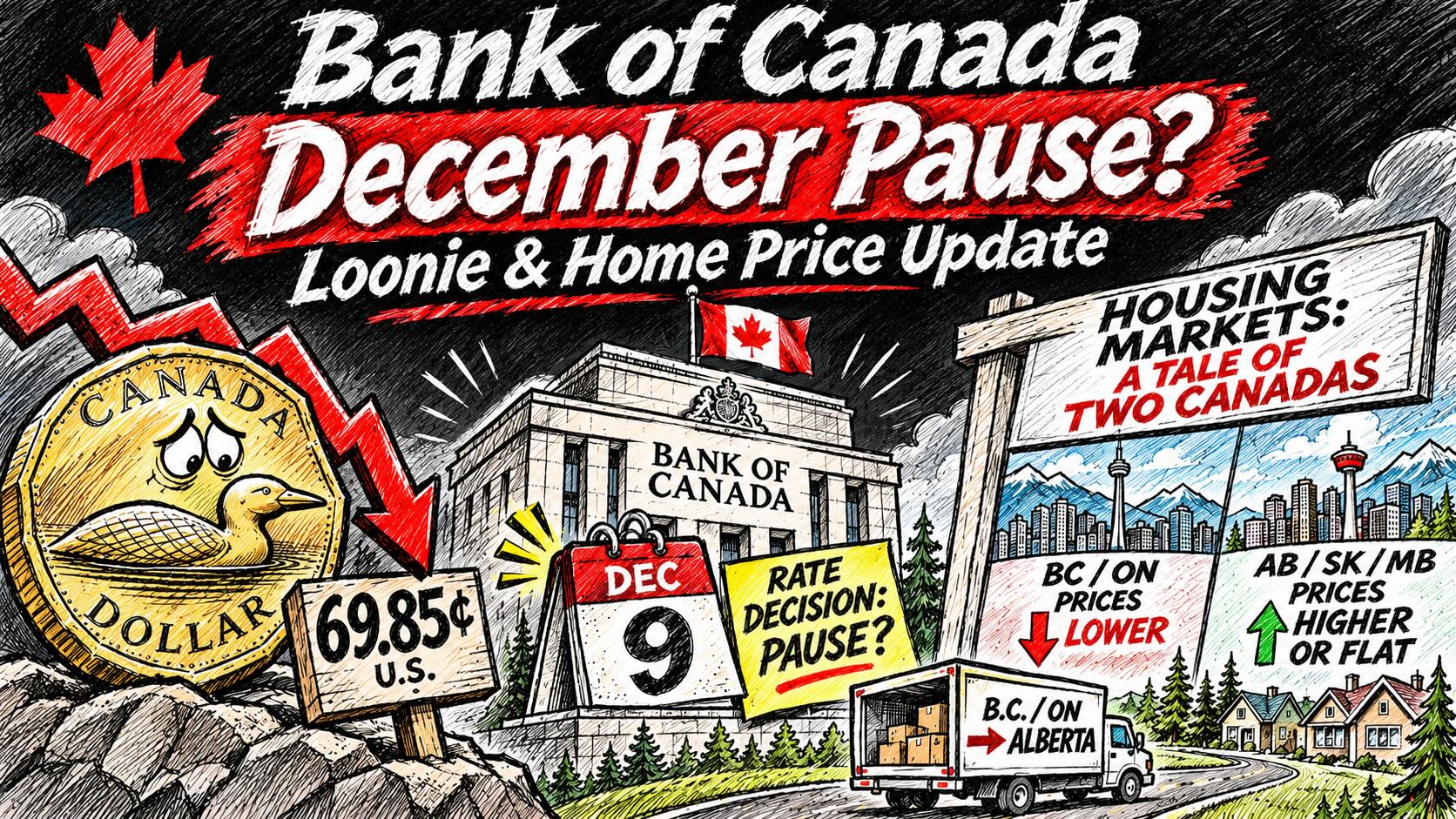
Two countries, two very different inflation stories. In the U.S., prices jumped more than expected in October, and another U.S. rate hike now looks all but certain. Here in Canada, inflation held steady, and once you take gas prices out of the picture, it’s sitting right on the Bank of Canada’s 2% target. With the Bank’s next rate decision coming on December 9, here’s what that means for your mortgage, your wallet and where rates go next.
The short version
- U.S. inflation is running hot. Prices rose more than expected in October, and the U.S. Federal Reserve is widely expected to raise interest rates in December.
- Canadian inflation held steady at 3.1%. That’s still above the Bank of Canada’s 2% target, but the increase is mostly gas prices. Take out energy, and inflation is right at 2%.
- That’s good news for borrowers. The calmer Canadian numbers make another Bank of Canada rate hike on December 9 less likely. My view is that the Bank will hold.
The U.S.: inflation is running hot
The U.S. inflation report released on Tuesday, November 10, showed prices rose 0.4% in October alone. That’s more than economists expected, and more than U.S. policymakers want to see.
Because of the U.S. government shutdown in October 2025, there’s no year-over-year inflation number for October 2026. For context, inflation over the 12 months to September was 3.7%.
The more telling number is core inflation, which strips out food and energy to show the underlying trend. U.S. core prices rose 0.3% in October, the third month in a row at that pace. Keep that up for a full year, and it works out to roughly 3.7%, nearly double the U.S. Federal Reserve’s 2% target. Housing alone accounted for more than 30% of October’s overall increase.
Lower oil prices could help bring U.S. inflation down over time, if they stay low. But other things are still pushing prices up: rising housing costs, tariffs on imported goods, and above-target price growth in services. That’s why the outlook for U.S. borrowing costs remains “higher for longer,” and the Federal Reserve is widely expected to raise rates again in December.
Canada: good news on the inflation front
Canada’s October inflation report, released Monday, November 16, showed prices up 3.1% over the past year, the same as in September. That’s a sharp contrast with the surge in U.S. inflation.
Over the month, prices rose just 0.2%.
Gas prices are doing most of the damage
Gasoline prices are up 30.9% from a year ago. Part of that is a quirk of the math: gas prices dropped sharply in October 2025, so this year’s prices look especially high by comparison. Gas prices actually fell 2.5% from September to October, but they remain high because of ongoing conflicts in the Middle East and Ukraine.
Here’s the key number: excluding energy, inflation was just 2.0%, right on the Bank of Canada’s target. And the Bank’s preferred measures of core inflation averaged 1.9%. In other words, outside of energy, inflation is behaving. Compare that with the U.S., where underlying inflation is running at a pace of roughly 3.7% a year.
What else moved
- Groceries: up 2.0% from a year ago, slightly faster than September’s 1.7%, mainly because of fresh vegetables. Grocery prices are still rising more slowly than overall inflation, but they’re up almost 32% since October 2020, which is why the grocery bill still stings.
- Clothing: up 3.4% in October alone, the biggest monthly jump since 2019, as shipping costs rose.
- Cell phone plans: down 6.2% from a year ago, one of the few categories getting cheaper.
- Rent: rent growth is slowing, and in British Columbia, that helped bring inflation down.
- Property taxes: up 3.8% nationally this year, a smaller increase than last year’s 5.6%.
Does Canada have to follow the U.S.?
Not necessarily. When U.S. inflation runs hot, it’s easy to assume Canada is next, or that the Bank of Canada will raise rates in lockstep with the Federal Reserve. But the two countries are dealing with very different problems.
- In the U.S., the price pressure is broad. Housing, services, food and tariffs are all pushing prices up, on top of energy.
- In Canada, it’s mostly energy. Take out gas prices, and inflation is right around 2%. Rent growth is slowing, and core inflation is under control.
The Bank of Canada sets rates for Canada’s economy, not America’s. With different inflation problems, it’s reasonable for the two central banks to move at different speeds.
The risk if the gap keeps growing
That said, Canada can’t drift too far from the U.S. for too long. If the Fed keeps raising rates while the Bank of Canada holds, three things can happen:
- The Canadian dollar weakens. Investors tend to move money where interest rates are higher. A wider gap between U.S. and Canadian rates can pull money south and push the loonie down.
- Imports get more expensive. Much of what Canadians buy, from fresh produce to cars to electronics, is priced in U.S. dollars. A weaker loonie means paying more for those goods, which could bring inflation back into Canada through the side door.
- Fixed mortgage rates can rise anyway. Canadian fixed mortgage rates follow Canadian bond yields, which tend to move with U.S. bond yields. So even if the Bank of Canada holds, rising U.S. rates can still push Canadian fixed rates higher.
In other words, the Bank of Canada has room to hold for now, but not unlimited room. If the gap widens and the loonie slides, the Bank may eventually be forced to respond, even if Canada’s own inflation numbers look fine.
The economy is showing cracks
While inflation is steady, the job market is weakening. Canada has lost 41,200 jobs since the end of last year, the largest loss for this point in the year since the 2009 financial crisis (not counting the 2020 pandemic). The ongoing U.S. trade war is taking a toll.
A weaker economy is one more reason the Bank of Canada may be reluctant to raise rates again.
There’s also some hope on the energy front. Tensions in the Middle East appear to be easing, and some major forecasters expect an oversupply of energy heading into next year. If that happens, lower energy prices would help bring headline inflation down.
What this means for you
For your wallet
Prices are still rising faster than we’d like, especially at the gas pump. It’s nowhere near the summer of 2022, when inflation topped 8%, but high gas prices continue to eat into household budgets.
For interest rates
The Bank of Canada raised its policy rate in October to get ahead of any spillover from higher energy prices. So far, that spillover isn’t happening: outside of energy, inflation is right around 2%.
Add in a weakening job market, and the case for another rate hike on December 9 looks much weaker after this report. The U.S. Federal Reserve will likely raise rates in December, but the Bank of Canada doesn’t have to follow.
My take: Theoretically, I would think that the Bank of Canada (BOC) should hold. But, I expect they will increase by another 0.25% on December 9.
What should you do?
- Renewing in the next 6 to 12 months? Reach out now. My lenders let you hold a rate for 120 days or more, which protects you if rates rise.
- Thinking of buying? Get a fully verified pre-qualification. It holds your rate for 120 days and does the heavy lifting on your paperwork from the outset, so there’s far less uncertainty once your offer is accepted and your mortgage application goes live.
The bottom line
- U.S.: core inflation is running at a pace of roughly 3.7% a year, and a Fed rate hike in December is widely expected
- Canada: inflation held at 3.1%, but excluding energy it’s 2.0%, and core inflation is 1.9%
- The economy: Canada has lost 41,200 jobs this year, adding pressure on the Bank to hold off
- Watch the gap: if U.S. rates keep rising while Canada’s hold, a weaker loonie and higher bond yields could push Canadian fixed mortgage rates up anyway
Ready to talk about your mortgage?
I’m Marko Gelo, a dually licensed mortgage broker in BC and Alberta. Call or text me at 604-800-9593 — one application, one credit check, access to Canada’s top lenders.
Connect with Marko
Mortgage strategy, calculators, and direct access—without the bank-branch waiting room.
604-800-9593 ph1 | 403-606-3751 ph2 | mortgages@markogelo.ca
Download the Mortgage App for calculators and planning tools, or subscribe to get future posts delivered directly to your inbox.