November 23, 2026
Bank of Canada December Pause? Loonie & Home Price Update
The Canadian dollar just slipped below 70 cents U.S., the Bank of Canada has a real decision to make in December, and home prices across the country are heading in very different directions. Here’s what all three mean for your wallet, your mortgage payment, and maybe even where you decide to live.
The loonie takes a dip
This week the Canadian dollar closed at 69.85 cents U.S. — below the psychological 70-cent mark.
To put that in perspective, the loonie has only dipped below 70 cents a handful of times over the last decade, most recently in early 2023 and again in early 2025. Each time, it didn’t stay down there long. At its high points over that stretch, it was up around 82 or 83 cents.
You might be thinking: I don’t trade currencies — why should I care? Because as Canadians, we feel it every day. Sure, that U.S. vacation and cross-border Costco run just got pricier. But the bigger cost is harder to notice: so much of what we buy is imported. Groceries, electronics, car parts — a weaker loonie quietly makes all of it more expensive.
So why is our dollar falling? Three familiar reasons:
- Energy prices have softened. Our dollar tends to move with the price of oil.
- The interest rate gap has widened. U.S. rates are higher than ours, so investors can earn more holding U.S. dollars.
- The economy is sluggish. Tariffs are weighing on Canadian growth like a heavy backpack.
The good news? Economists expect the economy to gradually regain momentum, mainly as businesses start investing again. Just don’t expect a big bounce — the forecast is for the loonie to average around 72.5 cents next year. Nothing dramatic, just a quiet return to what we’ve come to know as normal.
The case for a Bank of Canada pause
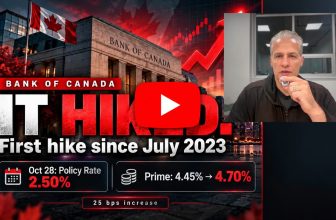
On October 28, the Bank of Canada raised its policy rate for the first time since July 2023. The quarter-point hike took it to 2.50% and pushed the prime rate to 4.70%. If you have an adjustable payment variable mortgage, your payment has probably already gone up.
So are more hikes coming? The Bank’s next decision is on December 9, and there’s a strong argument for sitting this one out:
- Jobs have fallen for three straight months.
- Third-quarter growth is tracking below 1.5%, well short of the Bank’s own 2% forecast.
- Oil prices have dropped well below what the Bank was assuming just weeks ago.
“But inflation is still 3.1%,” you might say. “Isn’t that exactly why they’re raising rates?”
It’s a fair question. But peel back the onion and almost all of that extra inflation comes from the earlier spike in energy prices. Strip out energy and travel, and the rest of the basket has actually been pulling inflation down. Core inflation is sitting at or below 2%. That’s right on target.
And here’s one that surprises a lot of people: rent. Just a couple of years ago it was one of the biggest drivers of inflation. Now it’s pulling inflation down, especially in Alberta.
| Peak rent inflation (2024) | Today | |
|---|---|---|
| Alberta | ~16% per year | ~−3% (rents falling) |
| Canada | ~9% per year | Under 2% |
Population growth has slowed and new rental supply is finally hitting the market — genuinely good news if you’re renting.
Markets currently see a December hike as a coin flip. The expectation from economists is a pause in December, followed by a possible quarter-point hike in January that would bring the policy rate to 2.75%.
There is no national housing market
“The housing market is crashing.” I hear it all the time. My question is always — which one?
There’s no single Canadian housing market. There are dozens, and right now they’re moving in very different directions. Here’s how benchmark prices compare:
| Province | Peak benchmark price | Today (approx.) | Change |
|---|---|---|---|
| British Columbia | Just over $1,000,000 (early 2022) | ~$870,000 | ~15% lower |
| Ontario | Just under $1,000,000 (early 2022) | ~$740,000 | ~25% lower |
| Alberta | — | ~$510,000 | Roughly flat over the past year |
| Saskatchewan & Winnipeg | — | — | Still climbing |
The price correction you keep hearing about is really a B.C. and Ontario story. Alberta’s benchmark price is holding steady and remains well above pre-pandemic levels, while Saskatchewan and Winnipeg have quietly kept climbing.
The gap between Canada’s priciest and most affordable markets has narrowed. At the peak, a benchmark home in Ontario cost more than half a million dollars more than one in Alberta. Today the gap is around $230,000 — narrower, but still massive.
And that gap is moving people. Alberta continues to draw a steady wave of newcomers from other provinces, especially Ontario, with a growing number coming from B.C.
The bottom line
A softer loonie, a Bank of Canada that may pause before hiking again, and housing markets moving in different directions all point to one thing: the right move depends on where you live, what kind of mortgage you have, and when it renews.
Ready to talk about your mortgage?
I’m Marko Gelo, a dually licensed mortgage broker in BC and Alberta. Call or text me at 604-800-9593 — one application, one credit check, access to Canada’s top lenders.
Connect with Marko
Mortgage strategy, calculators, and direct access—without the bank-branch waiting room.
604-800-9593 ph1 | 403-606-3751 ph2 | mortgages@markogelo.ca
Download the Mortgage App for calculators and planning tools, or subscribe to get future posts delivered directly to your inbox.