November 28, 2026
The Week Ahead
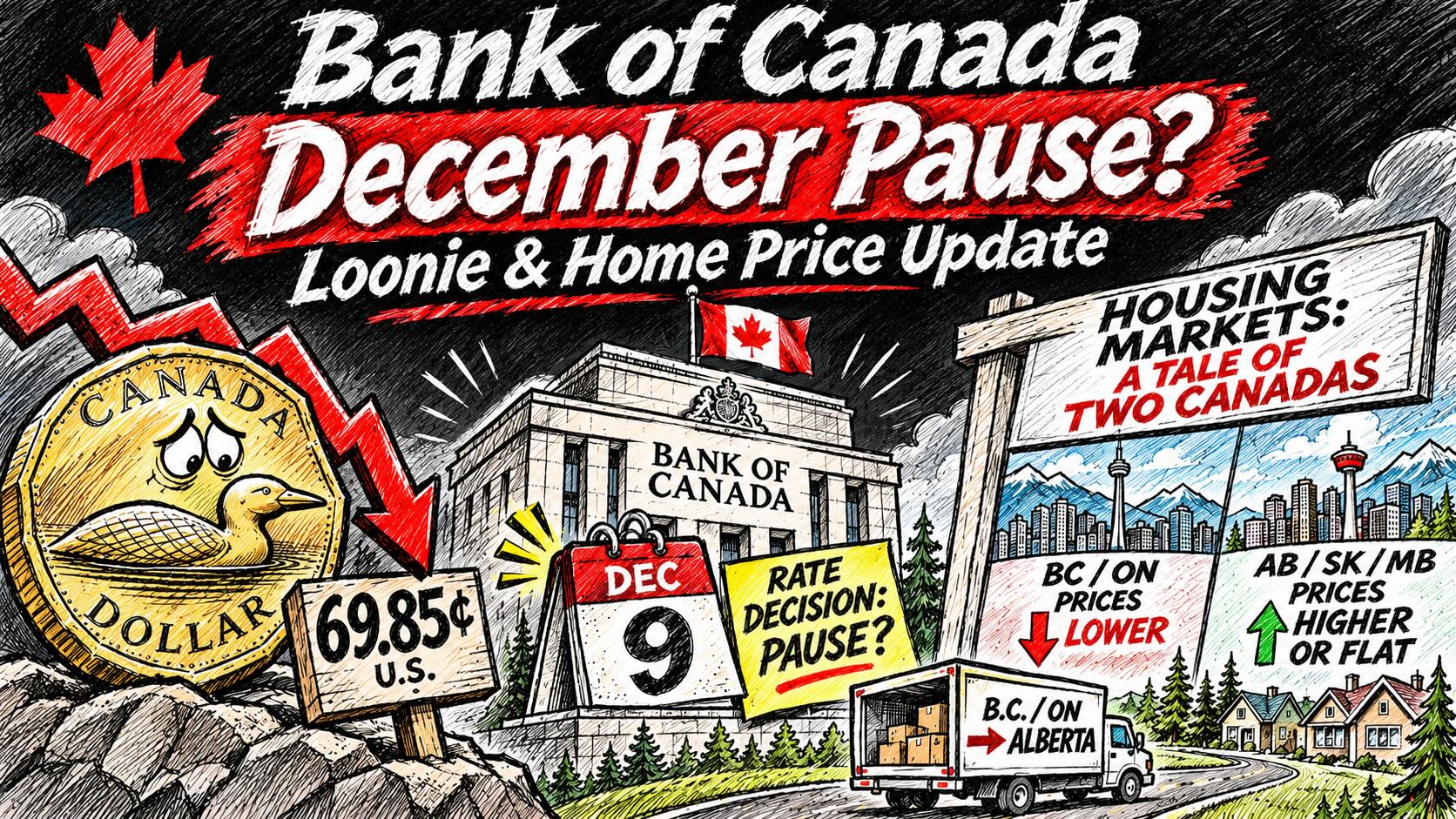
The last Bank of Canada rate decision of 2026 lands on December 9, and for once the honest answer to “which way will it go?” is: nobody knows. This week brought a renewed inflation target, a shift in the Bank’s language, record retail spending followed by a sudden pullback, and new research on what actually made Canadian homes so unaffordable. Here’s what caught my attention, and what it means for your mortgage.
The anchor holds: 2% is renewed to 2031
On Tuesday, Governor Tiff Macklem spoke to the Economic Club of Canada in Toronto. The headline was that the Bank and the federal government renewed the monetary policy framework for another five years, to 2031. In plain terms, the 2% inflation target stays in place, as the midpoint of a 1-to-3% range. No surprise there.
The more interesting part came next. Macklem said the Bank’s focus will stay primarily on headline inflation, meaning the prices you actually pay at the till. In his words, the main core measures can miss parts of the inflation story. Core inflation is the measure that strips out volatile components like energy and food shocks.
Why does that matter? Last week, a 1.9% core inflation reading was being tossed around as a reason to relax. This week, the Bank effectively set that number aside. Headline inflation is back in the driver’s seat.
The new argument for a hike
Softer energy prices mean inflation may not reach the Bank’s forecast of 3.5% by year-end. That sounds like good news for borrowers. But Macklem also pointed to business surveys suggesting that companies plan to pass higher costs through to customers in the year ahead, which lines up with historical lags.
That’s the new argument for raising rates. The Bank expects this second-round effect of the oil shock (higher costs spreading from energy into everything else) to make inflation more persistent.
So, hike or hold on December 9?
One major bank’s economists put it plainly this week: markets see a December hike as a virtual coin flip. Their call is a pause in December and a hike in January to 2.75%. The BCREA lands in the same place, calling for a hold at the final meeting of 2026.
My read: December is genuinely 50-50, and anyone telling you otherwise is guessing.
| The case to hold | The case to hike |
|---|---|
| Jobs are sluggish | Business surveys point to cost pass-through |
| Growth is sluggish | The Bank now flags persistence from energy volatility |
| Q3 growth tracking below the Bank’s 2% forecast | Headline inflation, not core, is the focus |
The consumer held, until October
September retail sales rose 0.8% to $75.3 billion, an all-time high. Alberta hit a record too, at $9.9 billion. In B.C., sales rose 0.3% on the month and 5.2% from a year ago, though Vancouver itself slipped 0.4%.
Resilient? Yes. But look at the turn:
- October’s early estimate shows retail activity pulling back 1.5%.
- Canada has lost over 110,000 jobs in three months.
- Third-quarter growth is tracking below 1.5%, short of the Bank’s 2% forecast.
The forward signals are soft too. Holiday spending plans average $911 per household, down from $975 last year, with Alberta highest at $1,184. The small business confidence index shows a split: the three-month outlook is 45.9 (anything below 50 means more owners expect things to get worse), while the twelve-month outlook is 57.3. That’s the widest gap in almost four years. Fifty-two percent of small firms cite insufficient demand, and more are planning layoffs than hiring.
For housing, this cuts both ways. Softer demand means less competition for homes, but it also means more income risk if layoffs pick up. For now, it’s wait and see.
What actually made homes unaffordable?
A comparison of 25 North American cities over 20 years looked at how much population growth drove home prices. The finding: population growth matters, but it doesn’t explain most of the difference in price growth.
- Montreal had the slowest population growth of Canada’s three largest cities, about 1% a year, yet the fastest price growth, at 5.6% a year.
- Houston added 2.4 million people since 2006, against Toronto’s 1.8 million over the same period. Yet Toronto prices climbed far more.
The two forces that do explain it are speculative demand, fuelled by very low rates before 2016 and during COVID, and limits on new supply: regulation, development fees and, in some places, geography.
Nobody will argue with the low-rate speculation part. The supply side is the frustrating one. Municipal bureaucracy and NIMBY opposition have turned project approvals into a years-long obstacle course of process, hearings and pushback, all before a shovel hits the ground.
Rates move demand fast and supply slowly
Bank of Canada staff research published Thursday put numbers on this. A sudden one-percentage-point rate hike hits demand fast but supply slowly:
- Within six months, resales drop about 10% and new mortgages drop about 15%. People stop buying almost immediately.
- Prices fall roughly 5%, but that takes a year or two to show up.
- New construction only adds about 1% a year to the total housing stock, so even a building slowdown barely dents overall supply.
Here’s the kicker: of the drop in new building after a rate hike, only about one-fifth comes from higher financing costs. The other four-fifths is builders pulling back because they expect weaker demand. It’s more of an expectations effect, rather than a financing-cost effect.
“So lower rates should make homes cheaper, right?”
The Bank’s own conclusion is that monetary policy can’t remove the structural barriers that limit how much housing gets built. Rates can cool demand, but they don’t build houses. When rates drop, demand comes back in months while supply takes years, so lower rates bid prices up, not down.
Keep the regional split in mind too. The price correction is mainly a B.C. and Ontario story, while the price gap between Alberta and the rest of Canada keeps drawing movers from Ontario and, to a lesser extent, B.C.
Rate check: what this means for your mortgage
The five-year Government of Canada bond yield, which fixed mortgage rates tend to follow, was 3.43% as of November 26, down nine basis points from 3.52% a week earlier.
| Product | Best rate |
|---|---|
| Insured 5-year fixed | 4.59% |
| Conventional 5-year fixed | 4.79% |
| Insured 5-year variable (Prime -1%) | 3.70% |
| Conventional 5-year variable | 3.99% |
An insured mortgage is one with mortgage default insurance, which is required when your down payment is under 20%. A conventional mortgage has 20% or more down and no insurance.
Variable is still about three-quarters of a point cheaper, and I think it’s a real option for the right borrower with the right product. That means:
- A static-payment variable product, where your payment stays fixed even if the rate moves
- Paying as if you’d taken the fixed rate
- Keeping a cash buffer
- Knowing your trigger point before you sign
If a quarter-point hike would break your budget, take the fixed and sleep well at night.
Mortgage tip of the week: don’t hold back on your application
When you fill out a mortgage application, be complete and be accurate. Tell your broker everything. There are many specialized mortgage products out there, each with its own qualifying criteria, and if your broker doesn’t know your full picture, they may not even be searching in the right sandbox.
Two examples:
- Medical students: There’s a special program for doctors still in medical school that lets them qualify on their projected income rather than their current income.
- Purchase plus improvements: This mortgage advances extra funds when you buy a home so you can renovate right away, with the renovation money built into the mortgage.
Your broker can only match you to the right product if they know the details: your profession, your plans for the property, coming income changes, other debts, other properties, gifts, support payments, all of it.
The application isn’t a test you pass or fail. It’s the map your broker uses to find you the best option. Draw the whole map when working through your application details.
What I’m watching next
On Monday, November 30, third-quarter GDP comes out. GDP is the official measure of how fast the economy grew from July through September. The Bank forecast 2%; some are projecting closer to 1.5%. It’s the last major data point before the December 9 decision.
Until then, stay light on your feet. If you have a renewal coming in the next six months, secure a rate hold, which locks in today’s rate for a set period while you decide. And it’s a good time to have a deeper conversation about variable versus fixed and which suits you best.
Ready to talk about your mortgage?
I’m Marko Gelo, a dually licensed mortgage broker in BC and Alberta. Call or text me at 604-800-9593 — one application, one credit check, access to Canada’s top lenders.
Connect with Marko
Mortgage strategy, calculators, and direct access—without the bank-branch waiting room.
604-800-9593 ph1 | 403-606-3751 ph2 | mortgages@markogelo.ca
Download the Mortgage App for calculators and planning tools, or subscribe to get future posts delivered directly to your inbox.