November 7, 2026
A federal budget, a renewed inflation mandate and a weak jobs report all landed in the same week. Some of the headlines sound like big news for buyers and investors. A few of them need clarifying. Here’s what actually changed, what hasn’t, and what it means for your mortgage.

The 2% inflation target isn’t going anywhere
Alongside the budget, Ottawa and the Bank of Canada renewed the inflation target. It stays at 2% through to the end of 2031.
You might be thinking that’s just a formality. It is, but it also sends a message. There will be no talk of “3% is the new 2%.” The Bank is staying rigid and focused on this one metric for another five years.
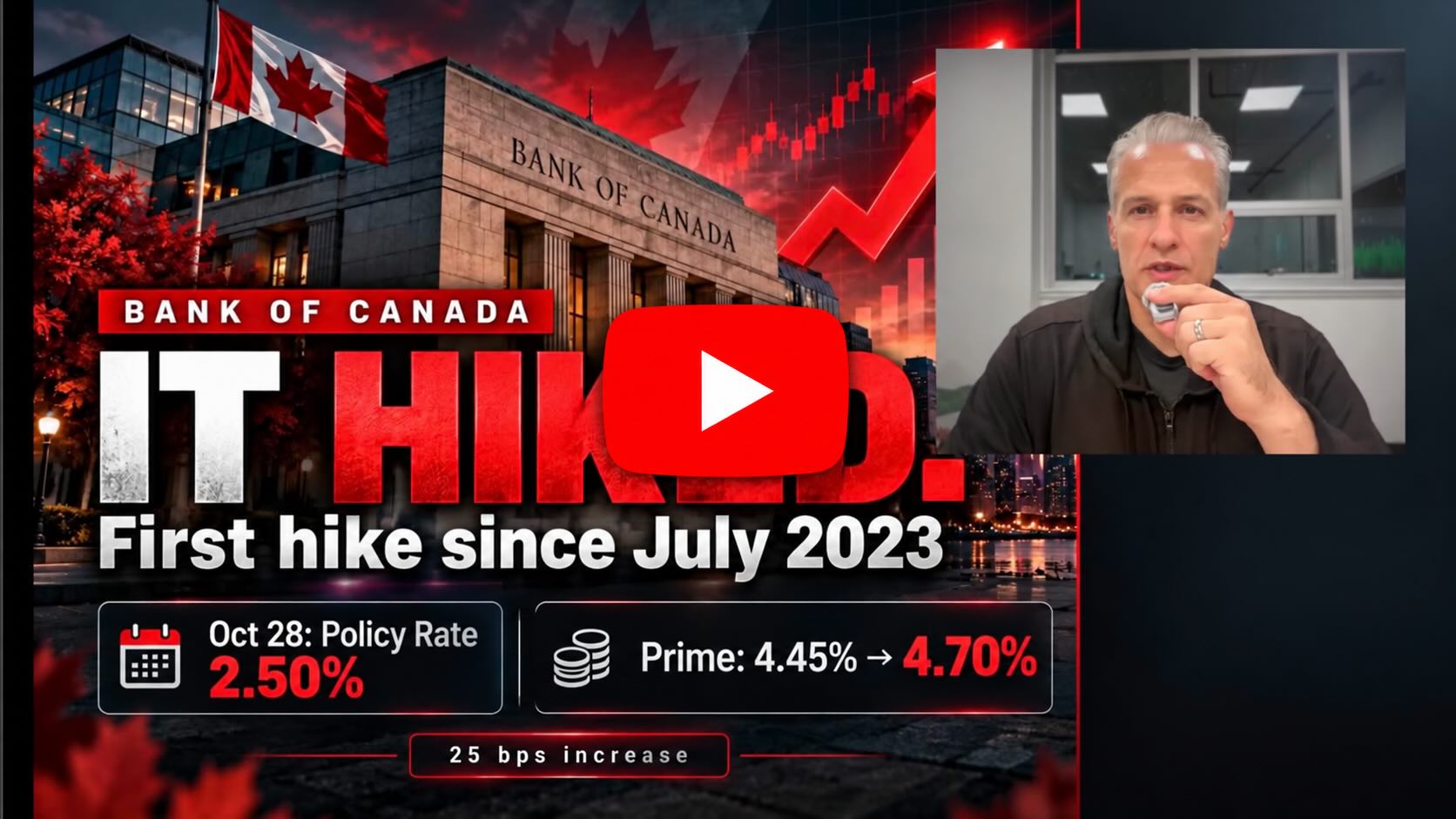
This is consistent with the Bank’s recent move to raise its policy rate by a quarter point to 2.5% on October 28, its first increase since July 2023. Expect the same message leading up to the next announcement on December 9. For what it’s worth, my call is that they’ll hold.
10% down on a fourplex: the real nugget, and the catch
The one real mortgage and real estate nugget in the budget is this: starting February 1, 2027, you’ll be able to get an insured mortgage on a triplex or fourplex with as little as 10% down. You won’t have to live in one of the units, and there’s no cap on the property value. On paper, a $2 million fourplex could be yours with $200,000 down.
But there’s a catch that a lot of the headlines are skipping. This only applies to newly built triplexes and fourplexes. It doesn’t apply to the older fourplex down the street, and it doesn’t apply to duplexes, which can be purchased with as little as 5% down only if you live in one of the units.
You’ll also still have to qualify:
- Debt service limits still apply. Your GDS ratio is capped at 39%, and your TDS ratio is capped at 44%.
- The stress test still applies.
- Rental income is an unknown. The government hasn’t said how much of the rental income can be used to qualify.
- Premiums are an unknown. We don’t yet know what the mortgage insurance premiums will be.
- GST may apply. Because these are new builds, GST may be added to the purchase price.
Between the new-build limit, the qualifying rules and the open questions, I’m still a bit reserved about the impact this will have, particularly in Metro Vancouver. Until I dig deeper into the numbers, I’m somewhat pessimistic about how these projects will pencil out at higher price points. Say, a $4 million fourplex with 10% down: that’s a $3.6 million mortgage, with payments that could exceed market rents. I dunno, we’ll see how this evolves.
Foreign buyers and Vancouver pre-sales: not a done deal
Is help on the way for Vancouver’s dormant pre-sale inventory? Possibly. But some reports make this sound finished, and it isn’t. As of today, nothing has changed.
The budget proposes extending the ban on foreign purchases of existing homes by two years, to January 1, 2029, while exempting new residential properties. Legislation and regulations still have to follow, and the budget doesn’t define “new,” so we don’t yet know how pre-sales will be treated.
Even if pre-sales are exempted, BC’s 20% additional property transfer tax on foreign buyers is still in place. On a $1 million never-lived-in pre-sale condo, that’s a $200,000 tax. Not $20,000. $200,000.
Exempting new homes from the foreign buyer ban is one thing, but the bigger bone of contention is BC’s 20% foreign buyer tax, which is set by the provincial government, not the Feds. So the federal proposal would essentially make foreigners eligible to buy new homes, but who’s going to proceed with a 20% tax staring them in the face, on top of the standard property transfer tax to boot? This is kind of a useless proposal unless BC’s provincial government is willing to reduce or remove that 20% tax. Maybe that’s the next headline? We’ll have to wait and see.
Vancouver and Calgary: two very different markets
Here’s where things stand in the two markets I work in most, based on a recent bank economics report.
Vancouver remains soft. October resales were almost 30% below pre-pandemic levels, and prices were down 5.2% from a year ago. Transactions were up an estimated 2.5% from September, which suggests a very slow recovery. Listings have dropped six months in a row but are still close to a decade high. Expect prices to keep easing in the near term, and buyers to keep some leverage.
In my view, the condo market is the real opportunity in Vancouver, especially on affordability. If you’re a first-time buyer or a move-up condo buyer, there are bargains out there.
Some will say the same about detached homes. But a $4 million property that drops to $3 million doesn’t move the needle for a first-time buyer. This is where the idea of a K-shaped market comes in: one group, usually with established equity from a home bought 15 years ago or from family holdings, keeps moving up, while most working buyers are priced out of detached homes entirely. For the larger, younger buying demographic, condos and maybe townhomes are the market that matters.
Calgary is sitting pretty balanced. Resales dipped about 4% from September, but that just reversed the prior month’s gain, and activity is still historically strong. Prices are essentially flat, down just 0.4% from last year. Near-record homebuilding is adding supply, while a relatively robust economy and population growth should keep demand in step.
Immigration: steady, not surging
There was speculation Ottawa might open the taps on immigration. It didn’t. The new plan holds at 380,000 permanent residents a year and 370,000 new temporary residents a year through 2029. Don’t expect a big new wave of housing demand from these targets.
The jobs report was weak, but don’t get your hopes up
Canada lost about 4,700 jobs in October, and unemployment rose to 6.7%. So weak jobs means lower rates, right?
Not necessarily. On the same day, the US reported 165,000 new jobs, well above expectations, and unemployment edged down to 4.1%. Markets now see around a 78% chance of a US rate hike in December.
Canada’s weaker economy should technically be signalling a pause, but US financial markets have a major influence over ours, including the bond yields that drive fixed mortgage rates. Yields did drop after the US midterms, but not meaningfully. Don’t expect a unified march of Canadian banks cutting rates unless we see a prolonged decline in yields.
Mortgage tip of the week: protect your credit score before renewal
If money is tight, three habits will keep your credit score from sliding:
- Stay under 60% of your credit limits. If you can’t, consider spreading debt across other cards. You’d carry the same total debt, but lowering the balance-to-limit ratio on each card can preserve or even improve your score.
- Avoid falling more than one month behind on any credit account.
- Do not miss a mortgage payment. This one is a killer.
Here’s something a lot of people don’t know: if you’re staying with your current lender and don’t need extra funds, a renewal typically doesn’t involve a fresh credit check or income verification. You can usually renew without any resistance at all.
But if your lender smells blood, it’s a different story. You may be at the mercy of their renewal rate and re-qualification terms. I’ve seen lenders hold a customer to a higher rate because of their credit history, and I’ve seen lenders drop a rate to keep them. There’s no real pattern. Sometimes they bend over backwards for a weak credit profile and shoo away a triple-A client.
Headlines vs. reality
| The headline | The reality | Status |
|---|---|---|
| Inflation target renewed | Stays at 2% through the end of 2031 | Done |
| 10% down on triplexes and fourplexes | New builds only; you must still qualify; rental income rules and premiums unknown | Starts Feb. 1, 2027 |
| Foreign buyers can buy new homes | Ban extension and exemption are proposed; BC’s 20% tax still applies | Not law yet |
| Immigration targets | Held at 380,000 permanent and 370,000 new temporary residents a year | Plan through 2029 |
| Weak Canadian jobs | Doesn’t automatically mean lower mortgage rates | Watch bond yields |
Talk to a broker before you sign
Mind your credit habits, and talk to a mortgage broker before your renewal, even if it’s a short phone call. A broker can help you prepare for the negotiation, or plan a perfectly timed escape before your situation gets worse. It could save you thousands over the next five years.
Ready to talk about your mortgage?
I’m Marko Gelo, a dually licensed mortgage broker in BC and Alberta. Call or text me at 604-800-9593 — one application, one credit check, and access to Canada’s top lenders.
Connect with Marko
Mortgage strategy, calculators, and direct access—without the bank-branch waiting room.
604-800-9593 ph1 | 403-606-3751 ph2 | mortgages@markogelo.ca
Download the Mortgage App for calculators and planning tools, or subscribe to get future posts delivered directly to your inbox.