October 19, 2026
Canada Mortgage Rates & Housing Update: October 2026
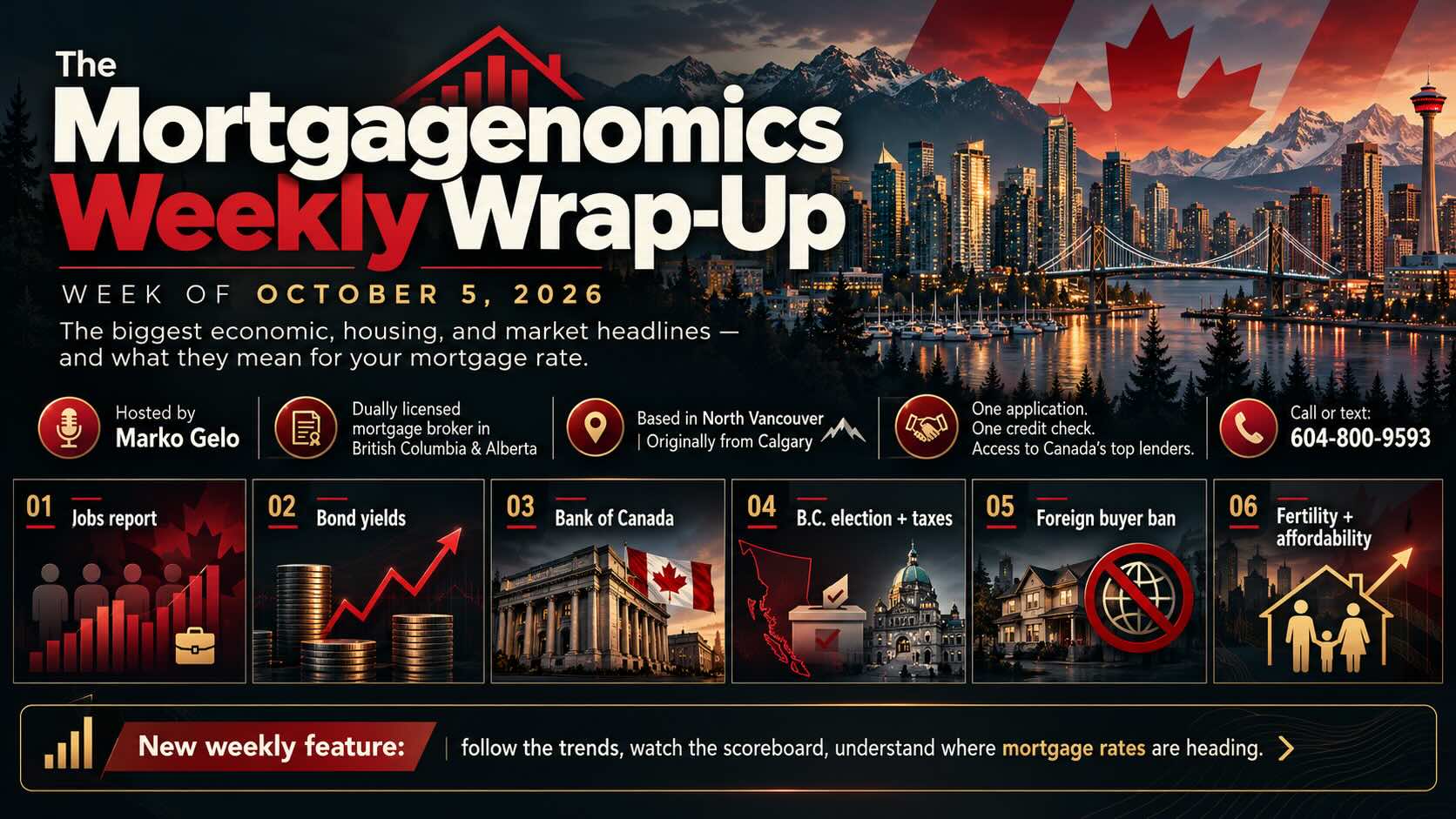
The Bank of Canada won’t make its next rate announcement until October 28. But if you’re waiting for that date to find out where mortgage rates are headed, you’re already a step behind. Fixed rates have been moving on their own for weeks, the national housing market just took a step backward, and Alberta heads to the polls on Monday.
Here are the five stories from this past week that could move your interest rate or the value of your home.
1. The Bond Market Isn’t Waiting for the Bank of Canada
Variable mortgage rates are tied to prime rate. That means variable rates won’t move until at least October 28, and possibly longer if the Bank holds steady.
Fixed rates are a different story. There are three main drivers behind that climb:
- Energy-driven inflation from the war with Iran
- Heavy government borrowing
- The massive AI build-out competing with bonds for investment dollars
This past week was calmer than the one before. A few lenders did make some sizable 20-basis-point increases, but they were the stragglers catching up to the big jump most other lenders made the week prior. Overall, fixed rates rose anywhere from 0.05% to 0.20%.
Canadian bond yields ended the week only slightly higher. U.S. yields climbed quite a bit more, and that’s the concerning part, because their bond market directly influences ours. Expect more gradual upswings in the coming weeks on both sides of the border.
Where the Bank of Canada Goes From Here
Markets currently put the odds of a hike on October 28 at about 30%. The higher odds are on a quarter-point increase on December 9 instead (this is the final scheduled Bank of Canada announcment for 2026).
Economists differ on timing, but they’re essentially all forecasting an upswing in prime rate through 2027. Some expect a quarter-point hike before the new year, while others don’t see a hike until after it. The longer-range forecasts I’m seeing call for a 1% to 1.5% increase in prime rate over the next three to four years.
Where Rates Sit Today
| Variable Rate | Fixed Rate | |
|---|---|---|
| Current pricing | Prime (4.45%) minus 0.45% to 1.00% | High 4%s to low 5%s |
| What moves it | Bank of Canada policy rate | Bond yields |
| Next likely trigger | October 28 or December 9 announcement | Daily bond market movement |
| Deepest discounts | Insured mortgages (up to prime minus 1.00%) | Varies by term and lender |
Insured mortgages typically get the sharpest pricing. That puts the spread between variable and fixed at roughly 1% to 1.5%. In my experience right now, there’s a lot of contemplating going on among people who are renewing, refinancing, or buying.
2. Canada’s Housing Market Took a Step Back
According to CREA, after four months of modestly optimistic news, national home sales fell 2.3% in September. The national benchmark price, which tracks the price of a typical home so you can compare like with like over time, slipped 0.4% on the month and is down 3.4% from a year ago. That takes prices back to roughly early-2021 levels.
Here on the West Coast, Greater Vancouver resales fell 6.2%, and Victoria dropped 25% in a single month, the sharpest decline in the country. For national context, the Greater Toronto Area fell 5.3%, and Toronto’s benchmark price now sits 27% below its 2022 peak.
The Flip Side
Listings fell too, which has kept prices from sliding faster. With 4.9 months of inventory (how long it would take to sell every current listing at today’s sales pace), the national market sits right in balanced territory.
In many pockets across the country, the opportunity is pretty clear: if you’re a buyer with a solid pre-approval, you’ve got more negotiating power than you’ve had in a while.
That said, this is a time to step away from the noise and do some private math. Moments like this are both opportunistic and cautionary. Take an honest look at your own finances, your lifestyle, your career trajectory, and all the other things that make your situation different from your neighbour’s. One person’s doom and gloom is another person’s opportunity.
The Market Isn’t Frozen
The headlines will have you believe the market is (literally) at a standstill, but that’s not the case. Deals are still getting done. There aren’t as many as in previous years, but there are certainly enough to show that buyers and sellers are still finding common ground.
Some buyers are landing homes with conditions and price concessions that would have been unthinkable five years ago. Some sellers who priced realistically and prepared their homes well are still walking away with results they’re happy with. And yes, some people on both sides are settling for less than they’d hoped.
That’s what a balanced market looks like. It’s a market where outcomes depend on preparation, pricing, and patience instead of luck and timing. The people winning right now aren’t the luckiest. They’re the most strategic, tactful, and realistic.
3. Alberta: Referendum Day and a Cooling Market
On Monday, October 19, Albertans vote on ten referendum questions, including whether to hold a binding vote on separation. A Chamber of Commerce survey found that 44% of Alberta businesses say the referendum talk is affecting them, and almost all of those say the effect is negative.
Even so, Alberta economists report the province is leading the country in job growth, population growth, and retail sales this year. The housing market has shifted from a seller’s market to a balanced one, mostly because a wave of newly completed construction has added inventory.
Alberta prices are only about 3% below their January 2025 peak. The gap between Alberta’s average price and the national average has narrowed to $143,000, down from $368,000 at its widest. Alberta is still cheaper, just not as much cheaper as it used to be.
We’ll have a better sense of where things stand once the results are in.
4. U.S. Inflation Is Running Hot
U.S. inflation jumped to 3.7% in September, and it isn’t just gas. Core inflation, which strips out food and energy, rose to 2.6%. The U.S. Federal Reserve already resumed hiking last month, and the U.S. 10-year Treasury yield is sitting around 5.1%.
Why should Canadians care about a U.S. bond yield? Because Canadian bond yields generally move with U.S. yields. When U.S. rates rise, ours usually follow, and so do our fixed mortgage rates, even if the two aren’t moving in perfect lock-step right now.
So get used to hearing about bond yields. They’ve become one of the main indicators for the economy and the markets. With the escalating Canada-U.S. trade fight and the U.S. midterms on November 3, my personal read is that we’re not done with fixed-rate activity just yet.
5. The K-Shaped Economy, Canadian Edition
This one is less a financial story and more a human one. In a “K-shaped” economy, higher earners keep doing better while everyone else falls further behind. New research from the C.D. Howe Institute suggests Canada has its own version of this:
- Savings rates have climbed for top earners and dropped for everyone else.
- Missed debt payments have jumped among 18-to-24-year-olds.
- Highly leveraged homeowners in Vancouver and Toronto are under the most pressure.
That last point is the one I’d keep an eye on, because many of those owners are heading into renewals at higher rates than they originally signed up for.
I can personally speak to this. The renewals and refinances coming across my desk right now are more complex, more time-consuming, and more emotionally demanding than I’ve ever seen. These used to be fairly straightforward. Over the past couple of years, they’ve become much harder to put together. There’s a lot of restructuring. Many clients are moving away from their current lender to one that’s more accommodating. And choosing the right term and product mix takes a lot more care than it used to.
So yes, files are taking longer. It’s not because of inefficiency. It’s because these are big, emotional decisions, and people understandably want time to work through them.
But that’s exactly where the stress comes from. That time runs straight into hard deadlines: the maturity date, the subject removal date (when a buyer’s conditions, like financing, must be removed), and the rate hold expiry. Those dates don’t move just because someone isn’t ready. The real tension is the gap between the time people feel they need and the time they actually have. In this market, there’s almost never as much time as people think.
The Bottom Line
Fixed rates have been on the move while everyone waits on the Bank of Canada’s October 28 announcement.
- If you’re buying: lock in a rate hold now. Most pre-approvals protect your rate for up to 120 days.
- If you’re renewing in the next six to twelve months: start the conversation early. Renewing ahead of your maturity date might make more sense for you than waiting.
Ready to talk about your mortgage?
I’m Marko Gelo, a dually licensed mortgage broker in BC and Alberta. Call or text me at 604-800-9593 — one application, one credit check, and access to Canada’s top lenders.
Connect with Marko
Mortgage strategy, calculators, and direct access—without the bank-branch waiting room.
604-800-9593 ph1 | 403-606-3751 ph2 | mortgages@markogelo.ca
Download the Mortgage App for calculators and planning tools, or subscribe to get future posts delivered directly to your inbox.