June 11, 2026
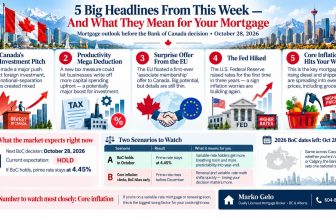
The Bank of Canada held its policy rate at 2.25% (which translates to a 4.45% consumer grade Prime Rate) this week — the fifth consecutive hold — and Governor Tiff Macklem essentially admitted that where rates go in 2026 is anyone’s guess. War, tariffs, oil: pick your wildcard. But if you read the Bank’s statement closely, it may be telling us more than the headline suggests.
The Dilemma the Bank Admitted Out Loud
Macklem’s framing was unusually candid: “economic weakness combined with rising inflation is a dilemma for monetary policy.” Normally, a weak economy gets cuts and rising inflation gets hikes. Canada currently has both — so the Bank is parked in wait-and-see mode. He then laid out the two roads explicitly:
- The cut scenario: if the United States imposes significant new trade restrictions on Canada, the Bank “may need to cut the policy rate further” to support growth — something we’ll learn more about as CUSMA talks heat up
- The hike scenario: if the Middle East conflict keeps energy prices elevated and that feeds generalized inflation, there “may be a need for consecutive increases in the policy rate”
What the Market Says vs What Economists Say
Most big-bank forecasters still expect rates to hold through 2026, with some pencilling hikes into 2027 — though many of those forecasts read like an echo of the Bank’s own messaging. The OIS market is telling a different story: it’s pricing in a hike by December. And every dovish economist’s opinion is already baked into that number.
The swing factor is oil. Crude and inflation have been moving nearly in lockstep — the recent correlation is north of 0.8, about as tight as macro relationships get. Either crude deflates, or the Bank’s “limited evidence” of energy pass-through becomes overwhelming evidence. Then come the hikes. Forward markets already reflect this tilt: the CORRA-implied path has prime rate stepping up from roughly 4.45% today toward 5.45% by 2031.
What This Means for Choosing a Mortgage Term
Choosing a term in a coin-flip environment is an exercise in odds-making — and the balance of evidence says inflation risks tilt to the upside. Run today’s forward curve through 5-year cost projections on a representative uninsured scenario, and fixed-leaning strategies model out cheapest:
| Rank | Strategy | Projected 5-Year Cost |
|---|---|---|
| 1 | 3-year fixed, then VRM | $58,453 |
| 2 | 5-year fixed | $58,539 (+$86) |
| 5 | 5-year variable | $61,143 (+$2,689) |
| 8 | Five consecutive 1-year terms | $69,798 (+$11,344) |
And here’s the kicker: fixed still projects cheapest even if the first hike doesn’t arrive until March 2028. That’s how asymmetric the risk picture is. Keep in mind these projections are about total borrowing cost — your qualifying power is a separate question, governed by the mortgage stress test regardless of which term you choose.
The Wording Easter Egg
One more thing. In the Bank’s statement, hikes are described as a sequence (“consecutive increases”) while easing gets a single, solitary “cut further.” That asymmetry is not an accident — BoC drafters choose every word with purpose. The Bank also retired April’s mild line that oil pass-through “warrants close attention” and swapped in a firmer vow not to “let higher energy prices become persistent inflation.” It’s like the Bank is trying to tell us something — without saying it outright.
What Should You Do?
If your renewal lands in the next 12 months, secure a rate hold now — it locks today’s pricing while leaving room to improve if the cut scenario wins out. And if you’re torn between fixed and variable — give me a call, let’s discuss further.
Ready to talk about your mortgage?
Call or text 604-800-9593 to discuss your mortgage options.
Connect with Marko
Mortgage strategy, calculators, and direct access—without the bank-branch waiting room.
604-800-9593 ph1 | 403-606-3751 ph2 | mortgages@markogelo.ca
Download the Mortgage App for calculators and planning tools, or subscribe to get future posts delivered directly to your inbox.