October 12, 2026
Weekly Mortgage Market Wrap-Up: Jobs, Bonds & the BoC
Welcome to the first Mortgagenomics Weekly Wrap-Up. Every week, I’ll run through the biggest financial, economic and housing headlines and show you how each one connects back to your mortgage rate. Then we’ll finish with the same scoreboard of numbers every week, so you can watch the trends, see which direction rates are heading, and understand the forces behind them.
Canada’s September jobs report was a stinker
Canada lost 68,300 jobs in September, when economists were expecting a gain of about 10,000. Unemployment ticked up to 6.5%, and labour force participation fell to 64.8%, the lowest since 1997 outside of the pandemic. Most of the losses came from the public sector and young workers, and the U.S. tariffs that took effect in August are starting to show up in the numbers.
One bright spot: Alberta kept adding jobs, and its unemployment rate fell to 6.4%.
Bond yields dropped on the news, and the Canadian dollar fell to about 70 U.S. cents, its weakest level since April 2025. Put another way, one U.S. dollar now costs about $1.43 Canadian. That happens when investors expect our economy to slow and our interest rates to stay lower than America’s, so they move their money south, where rates are higher.
Why should you care? A weaker loonie makes everything we import more expensive, from groceries to that cross-border shopping trip, which keeps upward pressure on inflation. But there’s a silver lining for Alberta. Oil is sold in U.S. dollars, so a cheaper loonie means every barrel brings home more Canadian dollars for producers, and more royalty revenue for the province. It’s one more reason Alberta’s economy is holding up better than the rest of the country, and likely will for the foreseeable future.
The bond market: where your fixed rate comes from
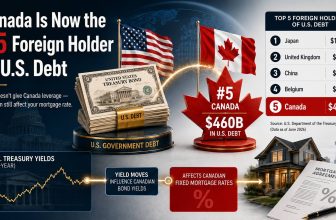
Fixed mortgage rates follow the 5-year bond yield. Earlier this week, that yield got close to its 52-week high at about 3.67%, and lenders across the board raised their fixed rates. After the jobs report, it fell back to roughly 3.55%.
Meanwhile, the U.S. 10-year Treasury yield hit 5.35% on Thursday, a 24-year high. The U.S. government is borrowing on an enormous scale, and corporate America is borrowing heavily to pay for AI.
You might be wondering why American bonds matter to a Canadian mortgage. The answer is that our yields usually move in the same direction as theirs. When U.S. borrowing costs climb, ours tend to get dragged along, even when our own economy is softening, which by the current numbers, it is.
The Bank of Canada on October 28
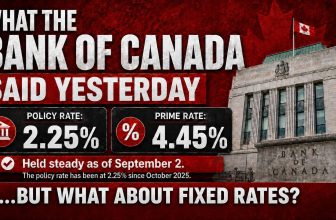
The Bank’s overnight rate sits at 2.25%, and prime is at 4.45%. Inflation came in at 3.0% in August, mostly because of energy prices tied to the Iran war. Markets are pricing roughly a 40% chance of a hike on October 28.
The swing factor is September’s inflation report, due October 19. If it doesn’t bring any nasty surprises, I think the Bank holds, especially after a jobs report like this one.
B.C. politics: campaigning on tax hikes in an affordability crisis
B.C. votes on October 24, and Premier David Eby has chosen a fascinating theme to campaign on: raising taxes. In an affordability crisis. Bold strategy. We’ll see how it plays out.
Here’s what’s on the table: higher rates on income above $190,405, and a brand-new bracket over $1 million, branded the “millionaire’s tax,” because nothing screams millionaire like a $200,000 household in Coquitlam. For good measure, there’s also a new tax on developers’ unsold condos. Because clearly the fix for a housing shortage is to punish the people building the housing.
To be fair, the NDP’s own math says it’s only about $192 a year at $200,000 of income. But it’s not really about that. It’s the direction, and the tax-everything mindset. The province is staring at a projected $13.8 billion deficit, and the answer is to reach a little deeper into the pockets of the doctors, engineers and business owners B.C. is already struggling to keep.
The public isn’t exactly cheering. Cost of living is the number-one issue for 57% of British Columbians in Angus Reid’s latest poll. Eby’s approval sits at 34% with 48% disapproving, and the Conservatives lead the NDP 43% to 37%, according to Liaison Strategies. Calling an election because you taste blood, then campaigning on tax hikes, could end with a pie in the face. Get out and vote, B.C. The stage is yours.
The foreign buyer ban is set to expire
The federal ban, officially the Prohibition on the Purchase of Residential Property by Non-Canadians Act, expires January 1, 2027. Ottawa appears to be considering a new model rather than another extension. Reports point to Australia’s approach, which lets foreign buyers invest in new builds and redevelopment but keeps them out of existing resale homes. Several economists say the ban never accomplished much anyway.
To be clear, only the federal ban is expiring. The provincial taxes aren’t going anywhere: foreign buyers will still pay an extra 20% in Metro Vancouver and 25% anywhere in Ontario, and there’s been no talk of removing them. Alberta has no such tax, which could make it the most open door in the country if foreign money comes back.
The one number that might matter most
Canada’s fertility rate is 1.26, a record low and well below the roughly 2.1 needed to replace the population.
Think about what today’s affordability is actually built for. For a lot of young families, the realistic entry point is a two-bedroom condo, and it takes at least $150,000 of household income just to qualify for one in Vancouver. A two-bedroom condo fits a mom, a dad and one kid. In a lot of ways, the housing market has quietly set the size of the Canadian family.
As a society, we’ve clearly shifted toward smaller families, and it’s something we have to seriously figure out. The default answer to the shortfall is immigration, but that’s expensive, and is it even sustainable? Until there’s a real shift back toward families of four or five, expect more of the same: ramped-up immigration and heavy investment in technology to grow GDP and maintain our standard of living.
If we want more young families, it starts with making it possible for them to buy a home.
The Mortgagenomics Scoreboard
| Metric | This Week |
|---|---|
| Next Bank of Canada decision | October 28, 2026 |
| Market odds of a hike | About 40% |
| Overnight rate / prime rate | 2.25% / 4.45% |
| Canada 5-year bond yield | About 3.55% (near-high of 3.67% earlier in the week) |
| U.S. 10-year Treasury yield | About 5.24% (24-year high of 5.35% on Oct. 8) |
| Metro Vancouver benchmark price | $1,075,900 (down 5.5% year over year) |
| Calgary benchmark price | $566,700 (down about 1%) |
| Edmonton benchmark price | $423,100 (basically flat) |
| GTA average sale price | $1,006,409 (down about 5%) |
Bonus: what it takes to buy
| Home | Approx. Household Income Needed |
|---|---|
| Vancouver two-bedroom condo | At least $150,000 |
| Vancouver benchmark detached ($1,784,700) | About $323,000 |
| Calgary benchmark detached ($739,400) | About $143,000 |
Estimates assume 20% down, a 25-year amortization, the stress test and a 39% GDS ratio. They include property tax and heating (plus half the strata fees for condos) and exclude other debts.
The bottom line
Fixed rates are drifting up because of bond markets, not the Bank of Canada, and a weak economy hasn’t been enough to pull them down yet. If you’re renewing or buying in the next 120 days, securing a rate hold is a no-brainer.
Ready to talk about your mortgage?
I’m Marko Gelo, a dually licensed mortgage broker in BC and Alberta. Call or text me at 604-800-9593 — one application, one credit check, and access to Canada’s top lenders.
Connect with Marko
Mortgage strategy, calculators, and direct access—without the bank-branch waiting room.
604-800-9593 ph1 | 403-606-3751 ph2 | mortgages@markogelo.ca
Download the Mortgage App for calculators and planning tools, or subscribe to get future posts delivered directly to your inbox.