Aug 25, 2026
A lot of people are treating “interest rates” as one story right now. It isn’t. There are two separate stories unfolding at the same time, driven by two completely different sets of forces — and mixing them up is exactly how some people end up making the wrong call on their mortgage term/rate decision.
Two Rates, Two Nervous Systems
The Bank of Canada’s policy rate — the one that drives your variable rate, and the bond market — the one that actually prices your fixed rate — respond to different inputs entirely. One reacts to domestic inflation and employment data (Bank of Canada). The other (bond market) reacts to, well, almost everything else: global bond flows, foreign trade shocks, investor sentiment on the other side of the world, a credit rating agency downgrade, a central bank in Japan or Europe deciding to buy or dump government debt, or a government bond auction in Washington that spooks investors halfway around the planet. Two completely different nervous systems, two completely different moods.
Story One: The Bank of Canada
The Bank of Canada held its policy rate again in July 2026, keeping it at 2.25% — or what shows up on your statement as a prime rate of 4.45%. A recent analysis from one of the big banks’ own economics teams put it well: a rate cut is possible, but it isn’t the base case — a view that lines up closely with where the data actually points.
The Bank has acknowledged that new U.S. tariffs could support a lower rate, since tariffs tend to slow growth. But counter-tariffs and rising energy prices pushed CPI inflation to 3.2% in May. Core inflation is still near the 2% target, GDP growth has resumed (around 2.5% in Q2 2026), and unemployment is soft but not collapsing. None of that points to an emergency cut — it points to a hold, with tariff turbulence more likely to delay a future hike than trigger a near-term cut. The Bank’s next scheduled decision is September 2, 2026, and market-implied odds of a cut currently sit well under 10%.
Story Two: The Bond Market and the CUSMA Breakdown
The less-watched story is arguably the more important one for anyone weighing a fixed-rate decision. On July 2, 2026 — CUSMA’s six-year review point — the U.S. declined a standard renewal, shifting instead to annual “rolling” reviews, putting roughly 90% of Canadian exports into year-to-year uncertainty. Talks kept deteriorating through the summer and broke down entirely this past weekend, when the U.S. confirmed 50% tariffs on Canadian autos, trucks, parts, and steel, stacked on tariffs already in place on other goods. Canada retaliated, with more signalled to come.
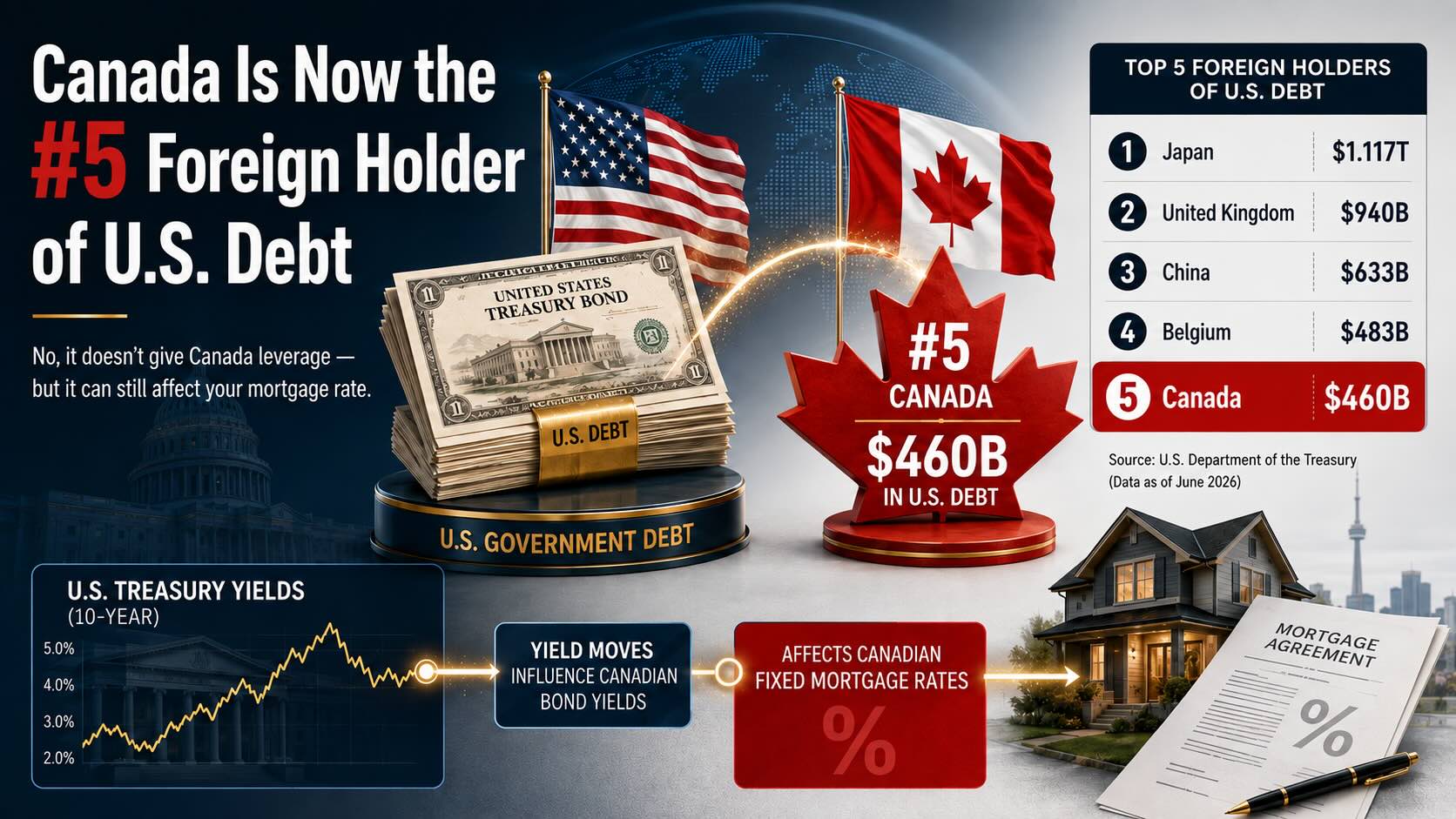
It’s tempting to assume a trade war automatically means lower rates everywhere. That’s not quite what happened. The Canadian dollar took the direct hit, falling to its lowest level in two months. But Canada’s 10-year bond yield actually climbed to 3.76%, its highest level since April 2024 — and that spike isn’t really about the trade fight at all. It’s happening mostly because of a broader global bond selloff: U.S. Treasury yields have been climbing on their own, pushed up by growing government deficits and sticky inflation concerns, and Canadian yields tend to move in lockstep with U.S. yields because global bond investors treat them as close substitutes. When American bonds get pushed higher, ours get dragged along for the ride, almost regardless of what’s happening in the trade conflict. When bond yields persist higher, mortgage rates tend to follow.
So where does the trade war actually show up? Mostly in how many future Bank of Canada rate hikes traders expect — not in the 10-year yield itself. Those are two different things: one’s a bet on what the Bank might do next year; the other is what global investors are demanding today to hold long-term government debt, and it’s the second one driving the most recent fixed-rate spike.
| Story One: Bank of Canada | Story Two: Bond Market |
|---|---|
| Drives variable rates | Drives fixed rates |
| Held at 2.25% (prime 4.45%) in July 2026 | 10-year yield hit 3.76%, a 2+ year high |
| Driven by domestic inflation/GDP data | Driven mainly by global bond-market forces |
| Base case: hold, possible delayed hike | Bond markets already volatile, CUSMA adds a bit more to it now |
What This Means for Your Mortgage Decision
If you’re on a variable rate, you’re tracking the Bank of Canada story — and that story currently points to a hold, not a cut. If you’re weighing a fixed rate, you’re tracking the bond market story — and that one is being pushed the other direction right now, mostly by global forces with a fresh layer of trade-driven volatility.
So there you have it – that’s the recap for today – keep checking in, stay informed!
PS: One date worth marking down: the Bank of Canada’s next scheduled rate announcement is September 2, 2026.
Ready to talk about your mortgage?
I’m Marko Gelo, a dually licensed mortgage broker in BC and Alberta. Call or text me at 604-800-9593 — one application, one credit check, and access to Canada’s top lenders.
Or visit homefinancingsolutions.ca to explore tools, calculators, and past episodes.
Connect with Marko
Mortgage strategy, calculators, and direct access—without the bank-branch waiting room.
604-800-9593 ph1 | 403-606-3751 ph2 | mortgages@markogelo.ca
Download the Mortgage App for calculators and planning tools, or subscribe to get future posts delivered directly to your inbox.