Feb 2, 2026
So here we are, with January 2026 firmly behind us—and what a month it was! …Okay, I’m exaggerating. It was actually pretty uneventful. Canada’s GDP remained flat, inflation is still kind of high (but not high enough to warrant an interest-rate increase), and the economy continues to sputter—though not persuasively enough in any direction to trigger any meaningful upward or downward bond-yield movement that would push rates either way.
If our economy were a beer, it would taste like a hazy IPA (try Fat Tug, by the way—my all-time favourite). IPAs are higher in alcohol, loaded with hops, and generally land on the fruity-yet-bitter side of the taste scale. One IPA? You’re fine. Two? Things can get sketchy and unpredictable. If anything, I’d recommend starting with one IPA, then scaling down to a Pale Ale, and finally ending with North America’s safe-haven beer: the always-reliable (and always on special) lager.
Okay, that’s enough beer-club talk—let’s get back on pint… I mean, point.
Bank of Canada announcement – a big nothing event.
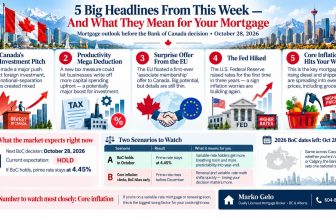
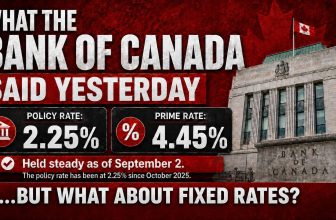
The first of eight interest-rate announcements came and went last week for both the Bank of Canada and the U.S. Fed, and both central banks chose to pause. Don’t expect any movement in the Bank of Canada’s Prime Rate for the remainder of the year, until the final rate announcement in December 2026, at which point economists are forecasting the first 0.25% increase. Beyond that, there are no further forecasts.
As for the U.S., expect the unexpected. There could potentially be a new (and somewhat dovish) Fed Chair at some point in 2026 if President Trump gets his way—Kevin Warsh being the name most often mentioned.
As it stands today, Prime Rate sits at 4.45%, and when paired with an aggressive discount, variable-rate mortgages can land as low as 3.55%. Meanwhile, fixed rates are ranging from roughly 3.99% to 4.44%, depending on term, loan-to-value ratio, and amortization.
This is what it all boils down to.
Just like that IPA from the opening, most things are fine in moderation. But once restraint disappears—and decisions start stacking up—the outcome becomes unpredictable. In real terms, it all comes down to the CUSMA review this July (the Canada–United States–Mexico Agreement).
In the best-case scenario, CUSMA is renewed for another 16 years, the next review is pushed to 2032, key exemptions are preserved, and some sector-specific tariffs are reduced or eliminated. In the worst case, the U.S. walks away entirely—and the exemptions walk with it. The most likely outcome probably sits somewhere in between: exemptions remain, but certain sector-specific tariffs linger. No matter how you slice it, the result is the same—persistent uncertainty, elevated speculation, and ongoing market volatility.
Layer on top of that the deeply troubling situation in Iran. From a market perspective, Iran’s role as a major oil exporter means heightened volatility in energy markets—and when energy becomes volatile, costs ripple through the entire economy. Sustained higher oil prices push inflation higher, and inflation eventually forces central banks to act. By the time those actions are formally announced, fixed rates have already likely moved higher.
So yes—this all matters. A lot.
Which is why the hope is simple: cooler heads, measured decisions, and just one IPA.
Better yet—let’s keep the taps limited to lager.
What to expect when it comes to mortgages.
Renewals
Whether they admit it or not, banks are up to their necks in “what-if” inquiries from concerned mortgage holders. As carrying costs rise, many borrowers renewing in 2026 are facing a meaningful payment shock—migrating from the 1–2% rate environment of 2021 to today’s 4.0–4.5% range. If you have a bank servicing agent proactively running renewal scenarios for you, consider yourself lucky.
Refinances
Refinancing sits a few notches higher on the paperwork-intensity scale, so expect the same mediocre—or worse—level of service from your banker. That said, many homeowners will look to refinance not just to renew, but to consolidate higher-interest debt in the process. Extended amortizations are also becoming a common tool to create monthly cash-flow relief.
Purchases
Stay organized and move quickly. Rate promotions are being launched sporadically and often come with tight closing windows. Being prompt with document delivery—and responsive to your mortgage broker or banker—can be the difference between securing a great rate and missing it entirely.
The Bottom Line
The world looks like it’s in a tailspin. But when you really think about it—when isn’t it? Yes, volatility and uncertainty dominate the headlines and drive the narrative, but the outcome is personal. It’s in your hands. It’s up to you.
As always, this is an environment where you need to manage the noise, assess your position, and—most importantly—pick your battles. Strip away the noise and the story becomes simple: real estate has been in a multi-year correction, and interest rates have come down and stabilized.
I’ll let you take it from here.
Cheers 🍻
CONNECT WITH MARKO:
604-800-9593 cell/text | 403-606-3751 cell/text | Schedule A Call | WhatsApp | Marko’s App | mortgages@markogelo.ca
Download my amazing Mortgage App…it’s loaded with calculators and tons of useful information!
Don’t want to miss out on the next blog post? Click Here to have future issues emailed directly to your inbox!