
November 15, 2026
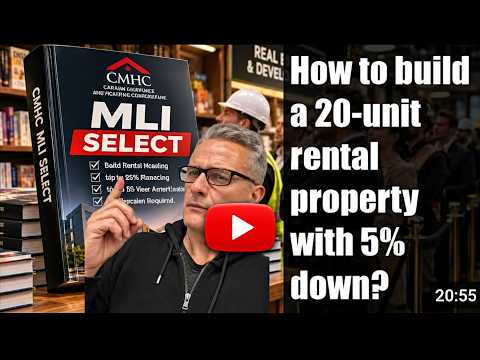
Some investors are buying and building apartment buildings with as little as 5% of their own money in the deal. The program that makes it possible is CMHC’s MLI Select, and it works in a way that surprises a lot of people: it rewards you for doing things that, at first glance, look like they’d cost you money, like renting some of your units below market for at least 10 years. (More on that later.)
It has also quietly become a lifeline for condo developers.
An olive branch for condo developers
For about two decades, the playbook for most developers in Vancouver and Toronto was simple: build condos and sell them, often as presales years before construction started.
Presales weren’t optional. To get a construction loan for a condo project, a developer typically has to presell somewhere around 60 to 70% of the units first.
No presales, no construction financing. No construction financing, no building.
And most of those presales were bought by investors planning to rent the unit out or flip the contract before completion.
Starting around 2023, that machine seized up. Interest rates jumped, condo rents stopped covering the cost of carrying a unit, and many investors who had bought presales a few years earlier were closing on units worth less than they paid. Investors walked away, and presale sales fell to some of the lowest levels in decades.
For developers, that was a crisis. They owned the land, had spent years and millions of dollars on approvals, and were paying interest every month on projects they couldn’t finance. Some couldn’t hold on, and a number of projects ended up in receivership.
That’s where MLI Select came in. CMHC didn’t design it as a rescue plan. It launched in 2022 to get more rental housing built. But when the condo market stalled, it became exactly that. With MLI Select, a developer needs no presales at all. Instead of selling the units, they rent them, and they can finance up to 95% of the cost of building with up to a 50-year amortization. Add the full GST rebate on new purpose-built rental apartments and CMHC’s low-cost construction loans, and stalled projects can move forward again.
The result is a real shift in the industry: builders who used to be sellers are becoming long-game landlords.
Isn’t renting a huge step down in profit?
That’s what I thought too, at first. A condo developer gets paid in one lump sum once the building is finished and buyers close on their units. But the gap is smaller than most people think:
- No sales costs. A rental building has no realtor commissions or big sales and marketing budgets, which can easily take 5% or more of a condo project.
- The GST rebate. On new rentals, that’s roughly another 5% of the project’s cost back to the builder.
- Better financing. They borrow more, at better rates, and repay it over a much longer period.
- They don’t have to wait 50 years to get paid. Once the building is fully leased, they can refinance and pull most of their money back out to fund the next project, or sell the entire building to a pension fund or a REIT. That’s still a lump-sum payday, just later.
The builder gives up some speed and certainty. In exchange, they get a project that actually gets built, ongoing rental income and a building that keeps growing in value. Selling a condo is a one-time payday. A rental building keeps paying.
The good news is that the same rules apply to investors and smaller builders, not just big developers. Here’s how it works.
Where residential ends and commercial begins
In Canadian mortgage financing, anything up to four units is residential. Duplexes, triplexes and fourplexes get residential mortgages, and the lender mostly looks at you: your income, your credit and your debt ratios.
At five units, you cross into commercial financing, and the building’s own rental income does most of the heavy lifting. Lenders check whether the rents comfortably cover the mortgage payments using the debt coverage ratio. Under MLI Select, the minimum is 1.10 for a standard rental building, which means the building’s net income has to cover its mortgage payments with at least a 10% cushion.
For the under-five-unit world, there’s a new insured program for newly built triplexes and fourplexes with as little as 10% down starting February 1, 2027. That’s the subject of Part 2 of this series. MLI Select lives on the other side of the line.
Is CMHC lending you the money?
CMHC is the Canada Mortgage and Housing Corporation, a federal Crown corporation owned by the Government of Canada. Most people know it for the insurance premium you pay when you buy a home with less than 20% down, but it also does housing research and runs a range of federal housing programs.
Because it’s called a CMHC program, many people assume CMHC lends the money. It doesn’t. CMHC is the insurer, not the lender.
- Your lender (a bank, credit union, monoline lender or other CMHC-approved lender) provides the money and holds the mortgage.
- CMHC insures the loan. If the borrower defaults, CMHC covers the lender’s loss.
- You pay for that insurance through a premium, usually added to the loan.
That insurance is what makes 95% financing, 50-year amortizations and often better rates possible. A lender will take on far more risk when the federal government stands behind the loan. It’s the same idea as an insured mortgage on a home with less than 20% down, just applied to apartment buildings instead.
One thing people often miss: the insurance protects the lender, not you. If things go wrong, the lender is made whole, but you can still be on the hook. That’s where recourse comes in, covered below.
CMHC does lend directly in some cases, such as its Apartment Construction Loan Program for rental builders. That’s a separate program. With MLI Select, your lender lends and CMHC insures.
What MLI Select actually is
MLI Select is CMHC’s multi-unit mortgage loan insurance program. It covers standard rental buildings, single room occupancy buildings, supportive housing and retirement homes. You need at least five units (or at least 50 units or beds for retirement homes), and it works for both new construction and existing buildings.
You earn points by committing to three things: affordability, energy efficiency and accessibility. The more points you earn, the better your financing gets.
| Points | Max financing | Max amortization | Recourse |
|---|---|---|---|
| 50 (minimum) | Up to 85% LTV (existing) | Up to 40 years | Full |
| 70 | Up to 95% LTV (existing) | Up to 45 years | Full |
| 100 | Up to 95% | Up to 50 years | Limited |
LTV is the mortgage as a percentage of the property’s value. For new construction, financing is measured as loan-to-cost instead (the mortgage as a percentage of the cost to build), at up to 95%. At each tier, the insurance premium also comes down.
How you earn the points
Affordability
This is the big one. You commit, for at least 10 years, to keeping a portion of your units at rents at or below 30% of the area’s median renter income, with capped rent increases on those units.
| Points | New construction: affordable units | Existing building: affordable units |
|---|---|---|
| 50 | 10% | 40% |
| 70 | 15% | 60% |
| 100 | 25% | 80% |
Committing for 20 years instead of 10 adds another 30 points. Because the bar is so much higher for existing buildings, affordability is mainly a new-construction strategy.
Energy efficiency
On an existing building, cutting energy use by 15% to 40% earns 20 to 50 points. On new construction, it’s about beating the building code by 20% to 70%. Either way, a qualified professional has to model it.
Accessibility
Accessibility earns 20 or 30 points for features such as barrier-free common areas, units that a wheelchair user can easily visit, and fully accessible units at the higher tier.
You can mix and match across all three. A new build with 10% affordable units and a decent energy upgrade can stack well past 50 points.
Why would anyone cap their own rents?
It’s a completely reasonable question: why would a builder voluntarily rent units below market and limit increases for 10 years? Isn’t that leaving money on the table?
Here’s a simplified example. A 20-unit rental project costs $8 million to build. With conventional financing, you might need 25% down, or $2 million of your own money. Now commit three of those 20 units (15%) as affordable. That alone gets you to 70 points and up to 95% loan-to-cost, so your equity drops to roughly $400,000.
Three units rent below market, but you’ve freed up about $1.6 million of capital for your next project or another investment. Add a longer amortization, which lowers your monthly payments, and a lower insurance premium, and for many builders that’s the difference between a project that pencils out and one that never gets off the ground.
The building still has to hit the debt coverage ratio, the numbers still have to work, and there’s real paperwork and ongoing compliance, including an annual affordability certificate. But once you see the trade-off, it’s clear why so many builders use this program.
Recourse: why 100 points matters
Recourse is what the lender can go after if a loan goes bad and selling the property doesn’t cover what’s owed. It’s the part many people skip over, and they shouldn’t.
- Full recourse (50 and 70 points): You’re personally on the hook. If a lender forecloses on a building with a $5 million mortgage and it sells for $4.2 million, they can come after you for the remaining $800,000: your savings, your other properties, all of it.
- Limited recourse (100 points): The lender’s recovery is mostly limited to the building itself. There are usually exceptions for things like fraud or misrepresentation, but your personal wealth and other buildings are far less exposed.
For an investor building a portfolio, limited recourse means one bad project doesn’t have to take down everything else you’ve built.
Who MLI Select is for
A good fit:
- Small builders putting up multiplexes and rental projects, especially in the 6- to 20-unit range, where 10% affordable units can get you in the door
- Investors who own a few rentals and are ready for their first apartment building
- Owners of older apartment buildings already planning energy upgrades, which can now earn better financing terms
- Supportive housing and seniors housing projects, which often score high naturally
Not a fit:
- Anything under five units
- Buildings where commercial space is more than 30% of the floor area or value
- Buyers affected by the foreign buyer ban
As popular as the program is, it’s still underused by mid-sized investors, and a lot of people in the fourplex world don’t realize how close they are to qualifying.
What’s coming next
The federal budget proposes letting Canada’s private mortgage insurers, Sagen and Canada Guaranty, insure rental buildings from 5 to 50 units, at up to 90% of a new project’s value with amortizations as long as 50 years. Right now, CMHC is the only insurer in this space. It’s still a proposal, not a done deal, but if it goes through it would bring real competition and potentially more options for investors and builders.
The bottom line
- Under five units: residential financing, plus the new 10%-down program for newly built triplexes and fourplexes starting February 1, 2027
- Five units and up: commercial financing, where the property’s rental income matters more than your personal income
- The bigger picture: with condo presales stalled, MLI Select has let developers keep building as landlords instead of sellers, and the profit gap is smaller than most people think
- MLI Select: earn 50, 70 or 100 points through affordability, energy efficiency and accessibility for up to 95% financing, up to 50-year amortization, lower premiums and, at 100 points, limited recourse
If you own a few rentals and are wondering what’s next, or you’re a builder trying to make a rental project work, MLI Select could change your math entirely. Let’s map out your project against the points system to see what it would take to qualify.
Ready to talk about your mortgage?
I’m Marko Gelo, a dually licensed mortgage broker in BC and Alberta. Call or text me at 604-800-9593 — one application, one credit check, access to Canada’s top lenders.
Connect with Marko
Mortgage strategy, calculators, and direct access—without the bank-branch waiting room.
604-800-9593 ph1 | 403-606-3751 ph2 | mortgages@markogelo.ca
Download the Mortgage App for calculators and planning tools, or subscribe to get future posts delivered directly to your inbox.